The generosity of a Hull firm of marine and farm paint manufacturers is enabling the railway locomotive which pulled the first passenger train on the world’s first heritage railway built by enthusiasts to be returned to the appearance it had on that historic day, 27th August 1960, as part of the loco’s centenary.
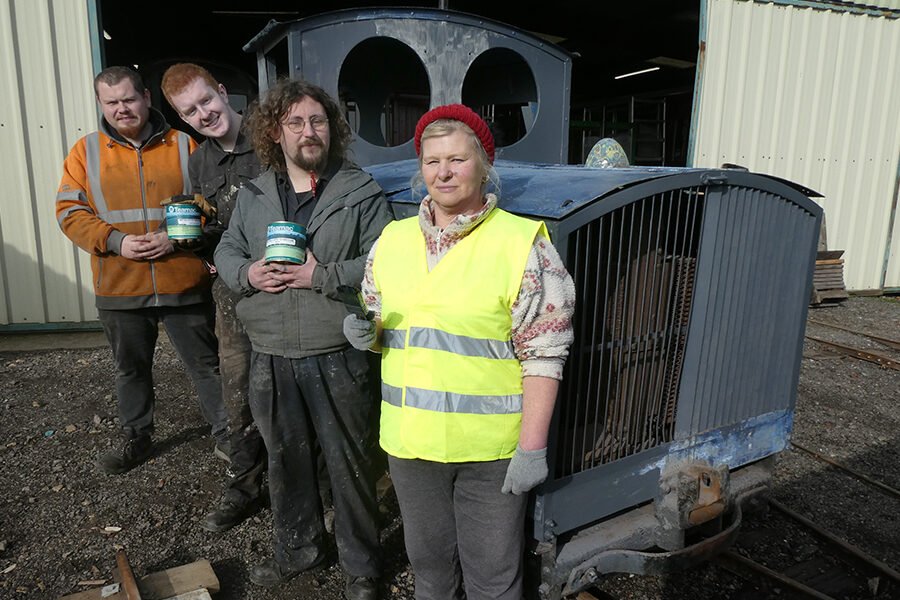
Teal & Mackrill Ltd. have given the Lincolnshire Coast Light Railway their Teamac Metalcote Enamel in Seine Net Blue, a colour traditionally associated with marine vessels, returning the loco to the livery it was finished in after the bodywork was fitted by a firm of sheet metal workers on Grimsby Docks.
The loco was built with a petrol engine in 1926 by the Bedford company of Motor Rail Ltd – one of their “Simplex” brand – for the Nocton Estates Railway, which operated for 23 miles across Nocton Fen in Lincolnshire, hauling loads of potatoes for Smiths Crisps and delivering beet to the sugar factory at Bardney. When built, it had no body, other than two metal bonnets covering the fly wheel and some other components. The driver had to face rain, snow and icy blasts across Lincolnshire’s fenlands without any protection. Before the Second World War it was converted from petrol to diesel power and then a home made wooden cab was fitted to give the driver some protection.
That was removed when the loco was sold in 1960 to the nascent Lincolnshire Coast Light Railway for the line they were building to connect the bus terminus in North Sea Lane, Humberston (near Cleethorpes) to the beach and the Fitties holiday camp. The job of providing a metal body was given to a sheet metal fabricating company on Grimsby Docks and it has carried that for the past 65 years.
Inevitably it became a bit battered with storage in the open at Burgh-le-Marsh and then, some limited use as the railway moved to the Skegness Water Leisure Park after the Humberston site closed. With the loco’s centenary in mind, volunteers on the LCLR have looked to returning it as far as possible to its 1960s’ appearance, including restoring the original colour.
Research showed the sheet metal company, more used to working with ships and marine equipment rather than railway locomotives, had finished it in Seine Net Blue produced by Teal & Mackrill in Hull.
An approach to the company explaining the historic significance of the retro-fitting exercise met with the generous response that the LCLR could have a Seine Net Blue supply, with undercoat, free of charge.
A team of volunteers is now engaged on straightening damaged sections, removing old paintwork and rubbing down the bodywork ready for undercoating and the Seine Net Blue top coat. The loco’s nameplate “Paul” (bestowed in the mid-1960s) has been removed but will be re-fitted in due course.
Chairman of the LCLR’s Historic Vehicles Trust, Richard Shepherd, said: “This is a wonderfully generous donation from Teal & Mackrill and will enable us to run our lovely pioneering Simplex in the state in which it operated the world’s first passenger service to run on a heritage line built by enthusiasts. We still have active volunteers who remember it from those pioneering days at Humberston, but the work is being carried out by some of the volunteers who’ve joined us more recently in Skegness.
“In restoring our heritage, they’re ensuring our future”.